
Ever since I posted my Kasut Manek (beaded shoes) photo, I have received several emails from readers around the world asking me how to bead for it. I decided to post some comprehensive tutorials in this area to cover all-you-need-to-know-how-to-bead-a-Kasut-Manek.
These tutorials are split into 4 parts, and we will cover the necessary steps, materials, and techniques involved:
- Part 1 – Preparing the Aida canvas frame (this tutorial)
- Part 2 – How To Bead The Outline
- Part 3 – Filling in the Design
- Part 4 – Measuring Your Foot (Optional)

This post may contain affiliate links, and we may earn a commission on purchases made through them at no extra cost to you. ❤️ Thank you!
Here we are, at the very beginning, with these tutorials on preparing your cross-stitch Aida canvas.
You need:
- A wooden frame measuring 11″ x 14″, preferably softwood like pine, so that you can press the thumb pins into it easily. Read more below to see alternatives.
- A 16-count Aida cloth cross-stitch canvas, white color, 11″ x 14″. Sew a border of 3.5″ width with cotton fabric.
- Some thumb pins.
- The shoe vamp of your foot size.
- Pencil
If you can’t find the wooden frame, you can always substitute it with easy clip frames (12 x 15 inches) or with a large embroidery 14″ hoop. You will need to resize your canvas to suit the frame you choose, but the minimum working area must be 11″ x 14″.
As you work along the beading process, the tension of the Aida cloth will eventually become lax. Re-tensioning is necessary so that your beading work is even.

Now, come back to our thumb pins option…
Double-fold the 3.5″ border and pin down the thumb pins to secure it, 4 pins on the short side and 5 pins on the long side.

Complete all 4 sides and make sure you pull the cloth in tension while pinned down so that it is tight and firm.

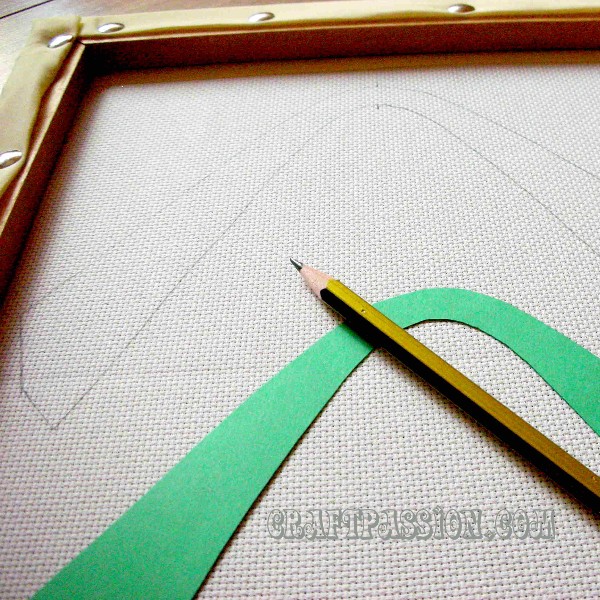
Trace the outline of the vamp template of your foot size with a pencil on your canvas. Mark the center line. Trace both the right and left sides of the vamp on top and bottom of the canvas, respectively (just flip the vamp’s paper pattern to change from left to right and vice-versa).
The pattern shown above is a simple casual thong-style sandal. There are several types of patterns for you to choose from: closed-toe, opened-toe, horizontal single-strap, horizontal double-straps, diagonal-straps, crossed-straps, and many more. Here are the four popular styles in US Size 6.
That’s it, and now your Aida canvas frame is ready for beading!!!!


Elizabeth
Monday 24th of November 2025
Penang style and Melaka style is slightly different too. Penang style has smaller beads and use aida or dmc cloth but my sister in Melaka doesn’t. Her beads are slightly bigger
Craft Passion
Wednesday 17th of December 2025
Totally agree — they each have their own charm.
Elizabeth
Monday 24th of November 2025
Patchlane at Sungai Dua in Penang also have patterns and beads
Serene
Wednesday 11th of September 2024
Hi there, thanks for your insightful write up . Would u happen to have templates for shoes-face? Open toe, close toe, cris cross?
& just wondering do u have any patterns you could share. Am living in Australia so it's hard to come by
Ursula
Wednesday 9th of March 2016
Dear Joanne
I am reading your blog with interest! I am traveling to Penang, just thought if you know where can I get the design and pattern for beaded shoes?
Thank you
Craft Passion
Tuesday 15th of March 2016
Hi Ursula, There is a shop at Penang Road (Komtar side), they have all the materials and info you need. The name of the shop is Sin Seng Lee. 515-517, Penang Road, 10000 George Town, Malaysia Hope this help and happy shopping.
Susan
Wednesday 9th of December 2015
Hi Joanne, may I know how to tie a big knot for starting and ending off? And do I need to weave thread behind stitches when I end off? Please help me. Thanks a lot.
Craft Passion
Wednesday 23rd of December 2015
Hi Susan, I tie a double knot and string the needle between the 2 threads after sewing the first bead (when the needle goes to the back), this method will avoid a big knot and also prevent the knot from coming off through the hole of the bead. For the end of the sewing, I thread my needle between the sewn thread and tie double knot for secure ending.