
Here is the last part of the locker hooking craft. We continue from the basic preparation in locker hook and how to locker hook; now, let’s finish up the final step on your locker hooking project and make it into drink coasters.


Aren’t you excited when you are approaching the finish line of a project? In the next step, I am going to show you how to tidy up the locker hooking project. The process involves hiding away all the ends (fabric strips and locking yarn) and cover up the back of the work.


I am so happy to have come up with these numbered coasters with the locker hooking technique! I brought them to Starbucks one afternoon when I needed a coffee kick to get my brains going. I took some photos of them with the coffee mug for the keepsake, as I am going to mail this to Diana, the lucky winner who won them in my January Giveaway Draw (the event has ended). Well, I can always reproduce them, but the feeling will be different.


I hope you enjoy these three parts of the locker hooking tutorials. Just like all my handmade crafts and tutorials, I have put a lot of effort into them because I believe beautiful crafts are meant to be shared and not kept to myself. Please throw in any questions or comments, as they are always open for you. I will try my best to answer, but if I can’t, I believe Theresa would be happy to help.


Also, you should get a copy of Theresa‘s “Hook, Loop ‘n’ Lock: Create Fun and Easy Locker Hooked Projects” she has plenty of beautiful locker hook projects and patterns there.
Previous Part Of Locker Hooking tutorials
Part 1: Basic Locker Hook Preparation
Part 2: Let’s Hook And Lock The Loops!!!
What’s Next:
- Start crafting and share your completed handmade on Facebook and/or Instagram. Remember to tag us, @craftpassion, so that we are able to see them.
- Pin it to Pinterest for a future To-Do List.
- Share with your DIY groups for a craft-along event.
- Browse more craft ideas to make.


How To Locker Hooking - Part 3 (Finale)
This is the final part of a 3 part tutorial to make numbered coasters with locker hooking method.
Part 1: Basic Locker Hook Preparation
Part 2: Let’s Hook And Lock The Loops!!!
Materials
- Locker Hooked Coaster
Instructions
- Hiding The Ends
a. Turn to the back, bring all the ends to the front by using a tapestry needle.
b. Insert the needle to the next square of the end, pass the end through the eye of the needle and pull it over to the front.
Never use the same square when passing the ends from back to front as you will undo your last loop.

- the back of the coaster is so tidy…


- The front is full of “ends”.
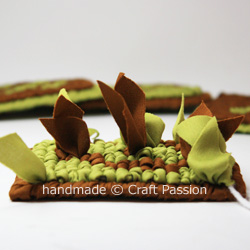

- a. Just like looping the ends of the border in the previous post, traverse the end by using the tapestry needle and bring them into the loops and hide it there.
b. Trim off the excessive length.
If you are afraid that end will come off for some heavy usage project eg. rug, you can apply some glue to the end.
c. Do the same to the locking yarn ends.

- After all the ends are hidden!


- Handling The Back
a. Iron on a piece of interfacing with the size smaller than the border. The loops will be extra secure if you do this step. The interfacing will glue the fabric in place and hence further lock it there.
b. Cut a piece of lining fabric for the back of the coaster with the size exactly to the dimension of the coaster.
c. Fold the 4 edges in so that it is slightly smaller than the coaster, iron it to fix the fold.

- Place it on the back of the coaster and secure it with pins.


- Stitch them up with slip stitch. Stitching on the coaster.


- Stitching on the lining.
You can use heatnbond double-sided adhesive interfacing for non-wash projects, in that case, you don’t have to fold the edges and stitch them up, just cut the lining to the exact size you want, iron it with heatnbond onto the coaster’s back.
Personally, I like to stitch them up though it is more time consuming, I like everything to be long-lasting and flexible, as I never know if I will wash the project one day even though it is just an ornament, it will cover with dust over time, right!

The locker hook coasters are ready to get into service!!!!

Gail
Wednesday 29th of May 2024
So if I am not cover the back of my piece how do I hook do that the mesh is covered??
How To Locker Hook Tutorial - Drink Coasters | Craft Passion
Friday 20th of September 2019
[…] Just look at the back of the coaster, I ended up having only 10 ends to manage. You can see that the back is flat without any messy zigzag crossing here and there. You are near to completion, just left the finishing touch and you are done! NEXT —> Locker Hook Tutorial: Finishing Touch […]
Jenny
Friday 10th of February 2017
I am starting to try this but the mesh is so stiff it is very difficult to work with, is there a way to soften it to make it more pliable?
Craft Passion
Friday 10th of February 2017
Hi Jenny, probably you have bought the different mesh which is made from poly fibre. Try massage it by rolling up the mesh then press it. Hope this helps.
Patsy Price
Tuesday 18th of February 2014
What size strips do you use For a coaster and rug. Thanks for the instructions. I've always wanted to do this but didn't know how to get started.
Craft Passion
Tuesday 18th of February 2014
Please read all the 3 parts of tutorial, starting with "the basic preparation" tutorial and you will be able to start this beautiful project very soon.
Candy Riffel
Sunday 31st of July 2011
Hi, I have tried to watch Theresa's video and my computer freezes before I can see the ending! How does she attach the tile to the center of the trivet? Just strong glue? I am dying to try this one. I just bought her book and this particular pattern is not in the book. Thanks for all your great ideas and help.
Craft Passion
Sunday 31st of July 2011
Hi Candy, Theresa used a strong permanent adhesive called Quick Grip to attach the tile on the trivet :)